
Will my build reuse the last one's work?
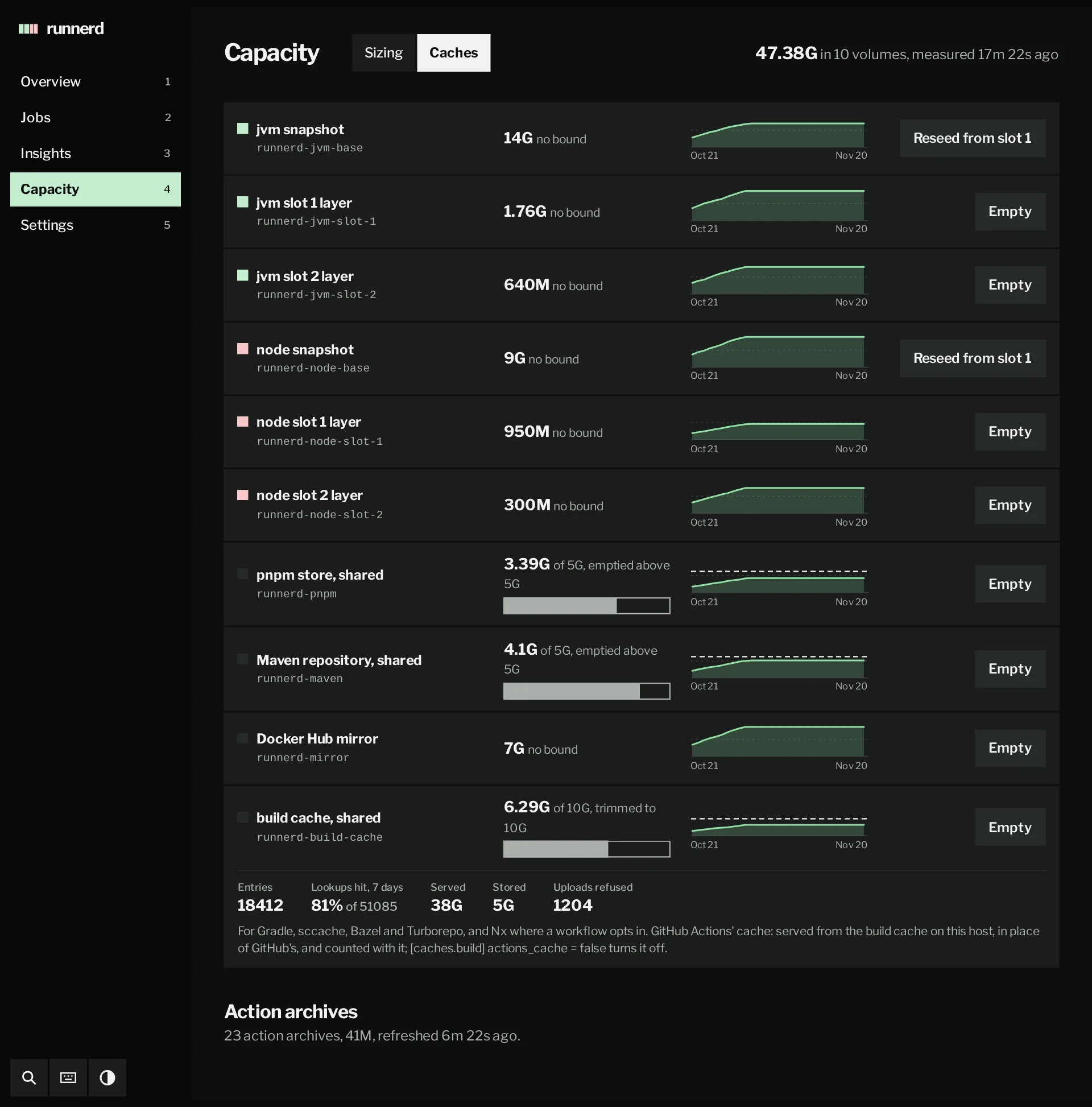
Yes, in three layers: the slot a job runs in keeps what the last job there left, a build cache per repository serves every slot, and actions/cache restores from this machine. runnerctl caches shows each volume, its size and the build cache’s hits:
$ runnerctl cachesmeasured 15m 01s agoVOLUME HOLDS SIZE LIMITrunnerd-jvm-base jvm snapshot 14G -runnerd-jvm-slot-1 jvm slot 1 layer 1.76G -runnerd-jvm-slot-2 jvm slot 2 layer 640M -runnerd-node-base node snapshot 9G -runnerd-node-slot-1 node slot 1 layer 950M -runnerd-node-slot-2 node slot 2 layer 300M -runnerd-pnpm pnpm store, shared 3.39G emptied above 5Grunnerd-maven Maven repository, shared 4.1G emptied above 5Grunnerd-mirror Docker Hub mirror 7G -runnerd-build-cache build cache, shared 6.29G trimmed to 10Gbuild cache for Gradle, sccache, Bazel and Turborepo, and Nx where a workflow opts in 18412 entries; 81% of 51085 lookups hit in 7 days, 38G served, 5G stored, 1204 uploads refused GitHub Actions' cache: served from the build cache on this host, in place of GitHub's, and counted with it; [caches.build] actions_cache = false turns it offaction archives 23 action archives, 41M, refreshed 4m 01s ago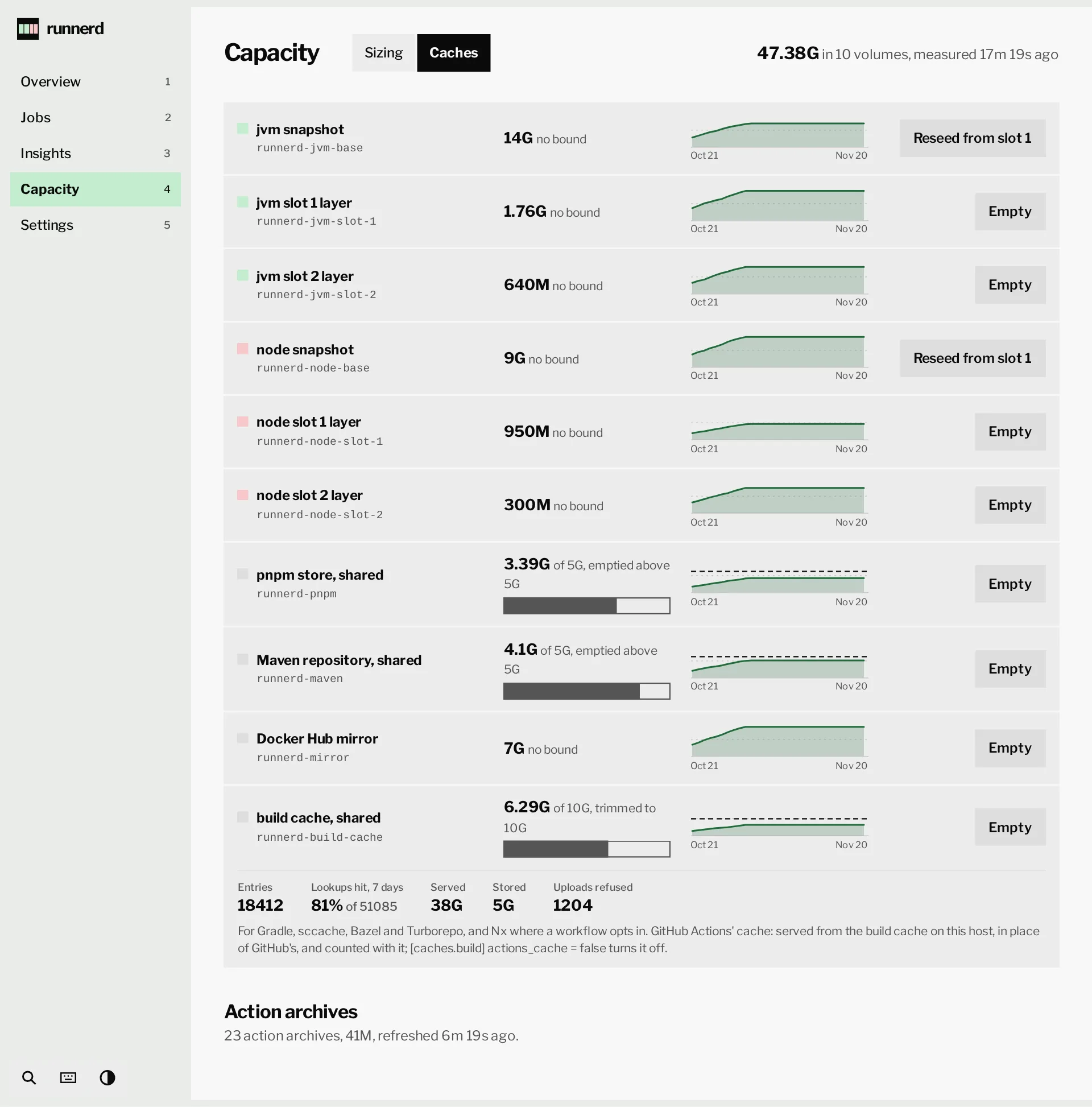
Warm caches
Section titled “Warm caches”Each job gets a new container, but its slot keeps a volume over the profile’s read-only snapshot, and a job goes to the slot that last ran it when that slot is free.
| Cache | Kept |
|---|---|
the slot’s Docker images, ~/.cache, tool cache, Android SDK |
per slot, between jobs, for every repository and branch |
| the slot’s Docker build cache | per slot. Build contexts go first, then layers, least recently used first, to about half the slot’s share; cache mounts (RUN --mount=type=cache) stay up to three quarters. Slots together get a quarter of the free disk plus what their volumes hold, 1 GB to 20 GB each. When Docker’s root is a file system in a file, the free disk is the lesser of its own and the free space under the file |
cargo credentials, Gradle’s gradle.properties and init scripts, Maven’s settings*.xml, Hugging Face tokens |
never kept. Anything else a job leaves, jobs of other repositories see (trust boundary) |
| the profile’s snapshot | replaced by slot 1’s changes once they reach reseed_at and the profile is idle, which drops every slot’s own changes. One that would pass snapshot_max starts the tool cache over from the image, then the Android SDK, and all of it when that is not enough, so Gradle and npm keep their caches when they can. Python environments made with a tool cache’s interpreter, as pipx’s and Poetry’s, go with it |
| pnpm store, Maven repository, Docker Hub mirror | shared by all slots; emptied above their max_size when no runner runs |
| build cache | per repository; least recently used entries go above build.max_size |
docker/setup-buildx-action starts a new BuildKit container per job, which keeps none of this; set driver: docker to build on the slot’s Docker Engine, as docker build does.
What a crash can leave
Section titled “What a crash can leave”Runners skip fsync, fdatasync, sync, sync_file_range and syncfs, which keep their caches whole across a power loss and cost the disk writes. Only runners of an image that carries the filter skip them; runnerd reads the image’s runnerd.skip-syncs label before each start, and a runner of an older image keeps its syncs. Their layers are mounted with overlayfs’s volatile option too, so a runner that stops does not make the disk commit what its layers wrote; a kernel that refuses the option gets the plain mount, which the runner’s output says. The Docker Engine inside a runner and its builds keep the sync their own overlays make when unmounted: Docker mounts a container’s files more than once, which volatile forbids. A container that stops or is killed loses nothing to either, and neither does an orderly shutdown or reboot, which writes everything before it powers off. A host crash or power loss can tear what runners wrote in about the last minute: a file comes back short, empty, zero-filled in places, or part old and part new, and a Docker Engine can start on a store whose databases are torn.
So runnerd empties what runners write after such a crash, before any runner starts:
| After the host boots again | |
|---|---|
| with a stop since that left no runner running | nothing is emptied |
| after an orderly shutdown or reboot, runners busy or not | nothing is emptied: the journal shows the shutdown’s final sync |
| after a crash, or a journal that does not say | every slot’s volume Docker has (layers and Docker store), of profiles and slots the config no longer lists too, and the pnpm and Maven volumes are emptied, after runnerd’s stopped containers on them; jobs start cold |
| a volume Docker does not remove | no runner starts until a later tick removes it. If a running container, or one that is not runnerd’s, mounts it, runners start on it after 5 ticks, a slot’s layers deleted first and its Docker store as it is, and the log names it and the docker volume rm to run |
runnerd reads the journal of the boot that ended. A host whose journal is not kept across boots (Storage=volatile, or no /var/log/journal), or whose runnerd user cannot read it, cannot tell a reboot from a crash and empties the caches after every boot once runners skipped their syncs; runnerd doctor says so and how to fix it.
Snapshots, the mirror and the build cache keep their syncs and are not emptied. A record keeps its files as they are.
The calls also return 0 on a file descriptor the kernel would refuse, so a test that expects fsync on a closed descriptor to fail fails here. skip_syncs = false under [host] keeps the syncs, for runners started after the reload.
Build cache
Section titled “Build cache”One store per repository, kept in ~/.cache/runnerd/build-cache, that every runner reaches: a task built in slot 2 is a hit in slot 3, and a pull request’s build gets what main built.
| Tool | Uses the cache when |
|---|---|
| Gradle | the build enables caching (org.gradle.caching=true or --build-cache) and sets no remote cache |
| sccache | the workflow runs it (RUSTC_WRAPPER=sccache) with no other backend |
| Bazel | .bazelrc sets no --remote_cache |
| Turborepo | always; a TURBO_API, TURBO_TOKEN or TURBO_TEAM the workflow sets wins |
| Nx | the workflow opts in (below) and uses no Nx Cloud |
Nx fails the run when its cache does not answer, so a step before Nx opts in:
- run: '[ -z "$RUNNERD_BUILD_CACHE_URL" ] || echo "NX_SELF_HOSTED_REMOTE_CACHE_SERVER=$RUNNERD_BUILD_CACHE_URL/nx" >> "$GITHUB_ENV"'A job writes only when GitHub says it runs a push, schedule or manual run (workflow_dispatch) of the default branch or of one of build.branches. With build_cache_writers = "pull-requests" (Configuration), a pull_request event from the repository’s own branch that a person, not a bot, opened, reopened or pushed to also writes. Anyone who can push a branch can then change what main builds load, so enable it only where that is you. runnerd asks GitHub about each job’s runner, trigger and commit; nothing a job writes to its log or environment counts. Every other job, fork and bot pull requests included, reads only; its uploads are answered as stored and dropped.
sccache uses the shared cache instead of its disk cache in the slot, not as well as it: a pull request’s own compilations are not kept, so a second push compiles again what the first did. A Rust repository with many pull requests may do better with its own backend or build_cache = false.
Containers a job starts itself, such as container: jobs, do not reach the cache. build_cache = false under a repository keeps it out; a workflow turns off Gradle’s part with RUNNERD_BUILD_CACHE_URL: "" and Turborepo’s with TURBO_CACHE: local:rw. runnerctl caches --clean runnerd-build-cache empties it.
GitHub Actions’ cache
Section titled “GitHub Actions’ cache”The build cache also serves actions/cache, the cache: input of setup-node, setup-java, setup-python and setup-gradle, and Docker’s type=gha cache, with no workflow change, in place of GitHub’s. Entries count within build.max_size. build.actions_cache = false under [caches], or a repository’s build_cache = false, leaves jobs on GitHub’s cache; runnerd doctor and runnerctl caches say which.
Entries are scoped as on GitHub, and only the jobs that may write save. A default-branch or build.branches job saves into its branch and restores from it, then the default branch. An opted-in pull request saves into its own scope and restores from it, then its base branch, then the default branch. Every other job restores from the default branch, and its saves report success and are dropped. Artifacts (upload-artifact, download-artifact) still go to GitHub through runnerd and fail while it restarts; the actions retry for about 25 seconds. container: jobs, docker:// actions and containers a job starts use GitHub’s cache.
Action archives
Section titled “Action archives”Before a job’s first step, the runner downloads every action the job uses from GitHub. runnerd keeps those archives on the host, and the runner copies one from there instead of downloading it. The runner still asks GitHub which commit each action is at, so an outage of GitHub’s API still fails a job’s setup; a failing download from GitHub no longer does for an action runnerd keeps.
Every 10 minutes at most, runnerd reads the workflows and action files on each served repository’s default branch. It keeps the public actions their steps pin by commit (uses: actions/checkout@08eba0b27e820071cde6df949e0beb9ba4906955), and the actions those pin in turn, nine levels deep. An action pinned by tag or branch, a local action, a docker:// image, a reusable workflow, a private action and an action whose archive holds a symbolic link are downloaded by the runner as before. Job logs never decide what is downloaded, and runnerd downloads archives without its token.
Each archive is checked before a runner can read it: it must be the tar git archive writes, unpack within size limits under one directory, with nothing leading out of it, and name the commit it was asked for. At start and at each refresh, runnerd checks every kept archive against what it verified. A changed one moves to quarantine/ and is downloaded again. A runner mounts the archives read-only, and only once that check found them good: a runner that starts while a check runs gets none. After a restart, runners that kept running with the archives mounted are counted until the first check, and named in the attention list if it moved a file they may have read. An archive stays for actions.keep after the last time a repository pinned it, and goes at once if its repository is no longer public. While a repository’s workflows cannot be read in full, what it last pinned stays, and the caches page says so. The archives take at most 8G.
When a job’s log shows the runner downloading an action as an immutable package, runnerd removes that repository’s archives and never keeps it again, since the runner would read the archive in the package’s place.
runnerctl caches and the dashboard’s Caches page show how many archives are kept, their size, when they were last refreshed, and what failed. A failure also shows in the attention list. actions.enabled = false turns them off.