Why is my job waiting?
Every queued job says what holds it, in runnerctl status, the dashboard’s overview and the TUI. Jobs are served oldest first; each gives the first reason that holds for it.
$ runnerctl status[...]JOB REPOSITORY WORKFLOW / NAME QUEUED WAITS FOR120055991720 halyard/storefront CI / lint 4m 51s ago No profile serves the label storefornt-small120055991710 halyard/storefront · node E2E / visual-diff 42s ago A runner is starting for it in node 2120055991711 halyard/storefront · node E2E / a11y 36s ago All 2 node slots are busy120055991712 halyard/storefront · node E2E / lighthouse 23s ago All 2 node slots are busy120055991713 halyard/storefront · node E2E / unit 10s ago All 2 node slots are busyIt will start by itself
Section titled “It will start by itself”| It says | Meaning |
|---|---|
| A runner is starting for it | A runner was registered and its container starts. GitHub gives a runner any job its labels match, so another job of the pool may take it. |
| All 2 node slots are busy | Every slot of the profile holds a runner. It starts when one ends. More slots: Sizing. |
| Needs 6G of memory; 2G of the budget is free | What its runner would reserve does not fit the slice’s MemoryMax beside what runs. Admission says what a runner reserves. |
| The slice is past 90% of its MemoryMax, so nothing starts | Under measured admission, the slice uses 90% of its budget; nothing starts until it falls. |
| Needs 4 CPUs; 1.5 are free | The CPU budget is spoken for. |
| Behind CI / build, which waits for memory | An older job goes first; younger ones wait behind it. The same for CPU. |
| Next after an older job, whose runner starts first | An older job’s runner is about to take the slot, memory or CPU this one would start with. |
| node is rebuilding its snapshot | Slot 1 is becoming the profile’s snapshot; none of the profile’s slots starts until it is done. |
| Pulling node’s image | A new runner image is pulling; the profile’s slots wait for it. |
| Emptying the caches a host crash may have torn | The host crashed while runners skipped their syncs, so runnerd empties the slots’ volumes and shared caches before any runner starts. Caches says what goes. |
It needs you
Section titled “It needs you”| It says | What to do |
|---|---|
| No profile serves the label storefornt-small | No pool of the repository has every label the job asks for, so no runner here can take it. Fix the workflow’s runs-on, or add the label to a pool’s labels. The overview lists it as needing attention. |
| halyard/storefront is paused | runnerctl resume halyard/storefront, or Resume on the overview. |
| Runners cannot register with GitHub; retrying in 2m | Runners of the repository failed, so none starts for a while. Also: runners cannot start, failed to take a job, or ended without a job. journalctl --user -u runnerd has the error; runnerctl doctor checks the token and Docker. |
| A host crash may have torn caches a container holds; once nothing mounts them: docker volume rm runnerd-pnpm | A container that is not runnerd’s, or that still runs, mounts a volume runnerd must empty after the crash, so no runner starts. Stop that container, or remove the volume once nothing mounts it. After five tries runnerd starts runners anyway, once the layers of each held slot volume are started over. |
The host is short of memory
Section titled “The host is short of memory”A runner also has to fit what the host’s memory leaves the slice: a desktop or local builds take RAM the budget assumed was free. The job then names up to three programs outside the slice holding 512M or more:
The host is short of memory: needs 6G; the host has 2G to spare; programs outside CI hold 30G, most java 9.3G and qemu-system-x86 5.8GClose them, or wait: runnerd starts the job once the host has room. The figure also counts the kernel and compressed swap, so closing them frees only part of it. When the host has memory but what runs may still grow into it, the job says so and names no programs. The host’s memory has the rules.
A job that has waited 30 minutes or more for the host’s memory, while the host lacks room for one that waits now, is also listed as needing attention, an insight and a notification, with the same programs named.
Let local builds yield to CI
Section titled “Let local builds yield to CI”A script that builds on the same host can ask before it takes more memory:
runnerctl status --waiting-for host-memory --repo halyard/ledgerIt prints nothing and answers in its exit code:
| Exit code | Meaning |
|---|---|
| 0 | A queued job waits for the host’s memory: it says The host is short of memory, or it waits behind an older job that does. |
| 1 | No queued job does, and runnerd listed every repository asked about at its last poll. |
| 2 | No answer. runnerd cannot see the queue: it just started, its listing of the repository failed or GitHub’s rate limit stopped it, or it is stopping. Or the daemon is not running or refused, it is older than this runnerctl, --repo names a repository runnerd does not serve, or the arguments are wrong. The error is on stderr. |
Without --repo it asks about every repository. Treat 2 as unknown, not as clear: CI may be waiting where runnerd cannot see it.
How long it waited
Section titled “How long it waited”A job’s page splits its wait at when runnerd first saw it queued (Seen by runnerd) and when its runner started: time before runnerd knew of it, time to start a runner, and the runner’s boot. A job that finds no runner waits 15 to 25 seconds for the next poll, a registration and a container start; a warm runner takes it within a second or two.
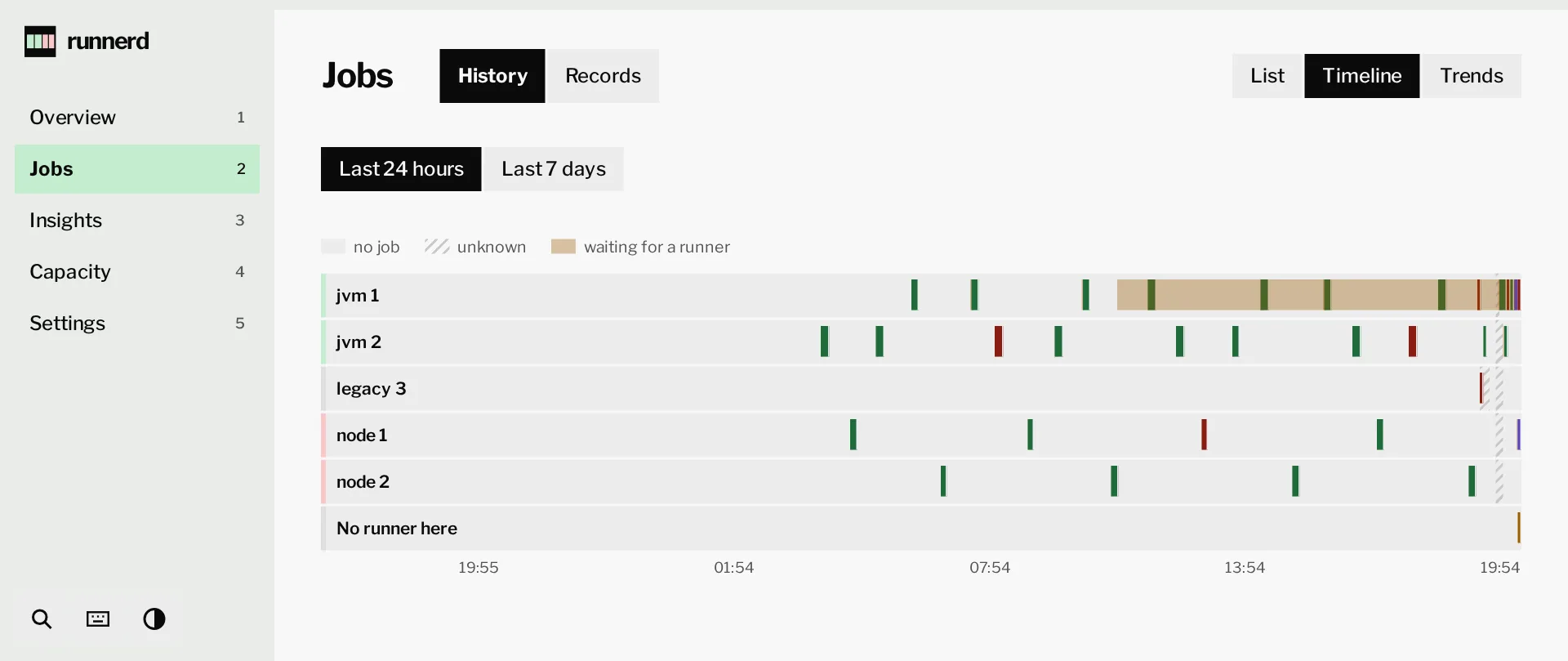
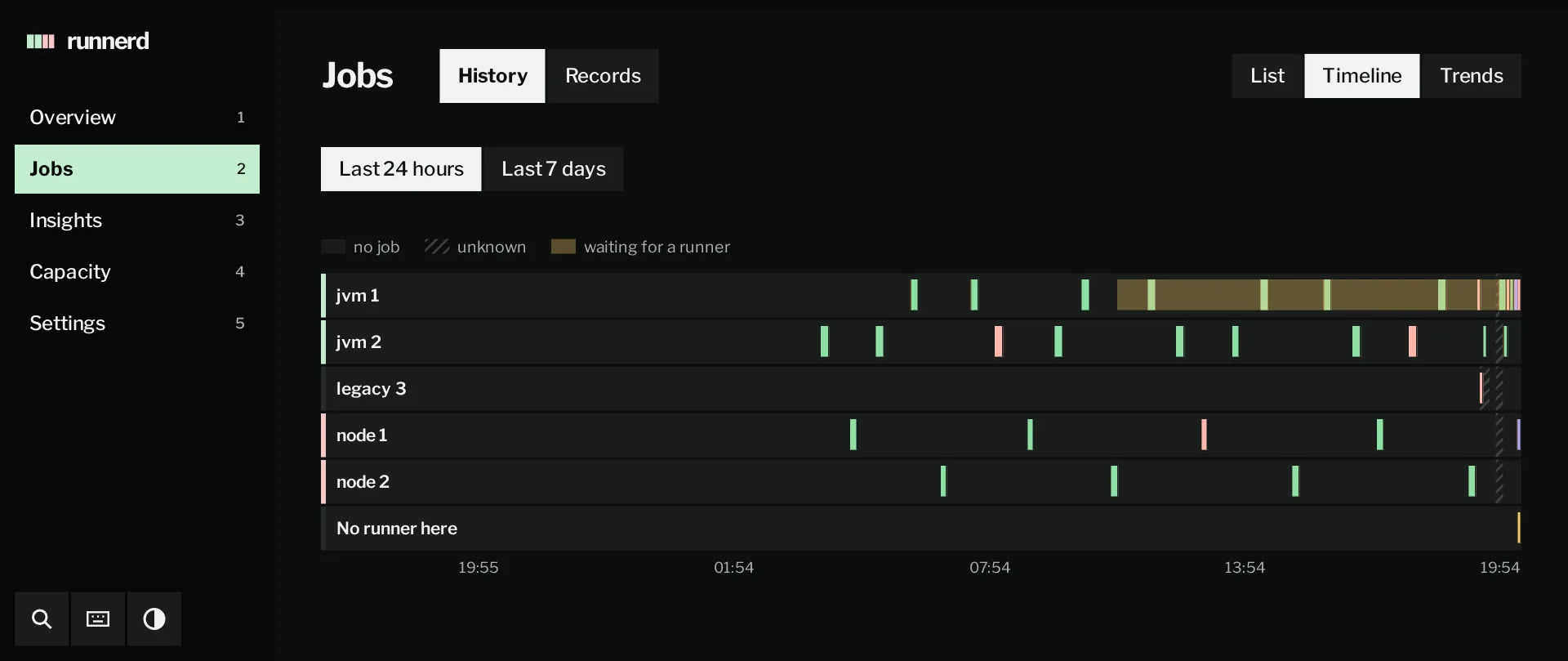
The Jobs page’s Timeline lens draws what each slot ran over a day or a week, with each job’s wait before its bar, so a run of waits shows where the slots were full.